Educational discussion of published research. Viking Stack products are for laboratory research only—not for human or veterinary use.
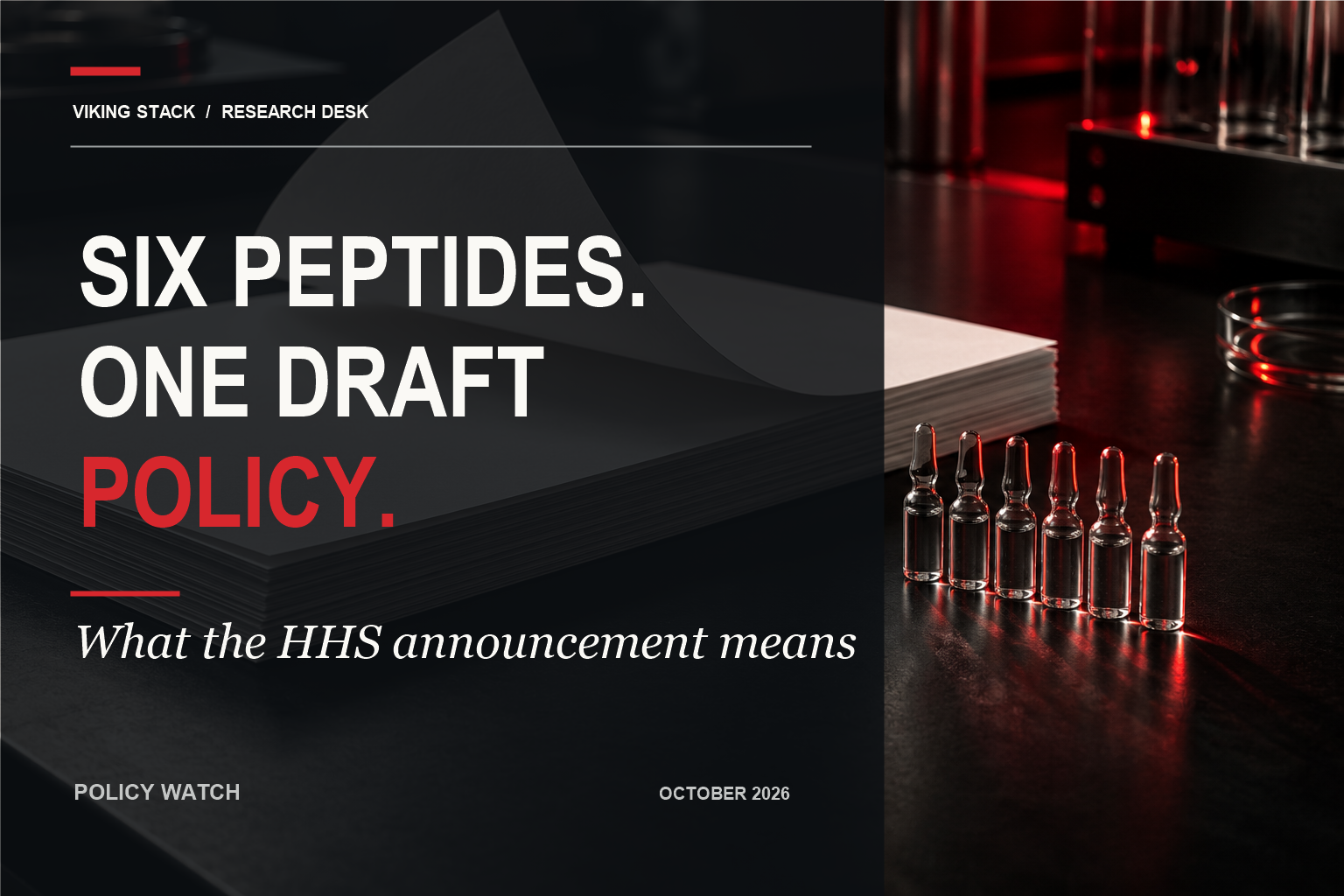
On October 28, 2026, the U.S. Department of Health and Human Services released a draft peptide policy for public review. It is a significant development for people following this field, and one worth understanding beyond the headlines.
As of October 29, the Federal Register notice schedules publication for October 30, followed by a two-week public comment period. This is a draft policy, not a completed or permanent change to peptide regulation.
The six peptides named are BPC-157, TB-500, Epitalon, KPV, MOTS-c, and Semax.
What the announcement addresses
HHS describes limited enforcement discretion for certain compounding activities under section 503A while formal rule making continues. It sets out circumstances involving qualifying state-licensed pharmacies, federal facilities, and licensed physicians. This is a specific compounding policy, not a general authorization for every peptide seller or product.
Compounded drugs are not FDA-approved. FDA approval reviews a particular drug for safety, effectiveness, and quality. A policy about compounding enforcement does not make that determination or validate claims about the named peptides.
Research interest is not clinical proof
There are reasons to investigate these compounds carefully. For example, a 2008 study in Gastroenterology reported that KPV reduced inflammatory signaling in cell experiments and changed measures of inflammation in two mouse models of colitis. Those findings identify questions for further study; they do not establish effectiveness in people.
Promising results matter because they give the next study something specific to test. Controlled research remains necessary to separate a reproducible finding from an encouraging early observation.
Identity and quality remain central
The draft HHS framework places conditions on documented manufacturing sources, certificates of analysis, contaminant testing, patient-specific prescriptions, and reporting of serious adverse events and product-quality problems. It also specifies one active pharmaceutical ingredient per compounded product and limits permitted forms and routes for individual compounds.
The announcement should therefore not be read as blanket authorization for peptide blends or online research products intended for human use. Viking Stack products remain strictly for controlled laboratory research, not human or veterinary use.
Reliable identity and quality documentation help researchers interpret results. An unexpected outcome may reflect the compound, the formulation, or a quality problem. FDA identifies contamination and incorrect active-ingredient amounts among the risks of poorly compounded drugs. Quality controls address those risks; they do not prove a peptide produces a desired benefit.
The next step is better evidence
More consistent products and better reporting could help researchers form clearer questions about outcomes, differences between study models, and unwanted effects. That is a possibility, not a guaranteed result of the draft policy.
The lasting value of this announcement will depend on clear implementation, reliable quality, useful reporting, and stronger controlled studies. Peptides deserve serious investigation, with findings that can be evaluated and trusted.
Research and policy education only. This article reflects documents available October 29, 2026; the draft policy may change. It is not a treatment or dosing guide.
Sources & further reading
This article is educational and does not establish safety, efficacy, or suitability of any Viking Stack product for human or veterinary use. Product descriptions are not medical advice.
← BACK TO ALL ARTICLES